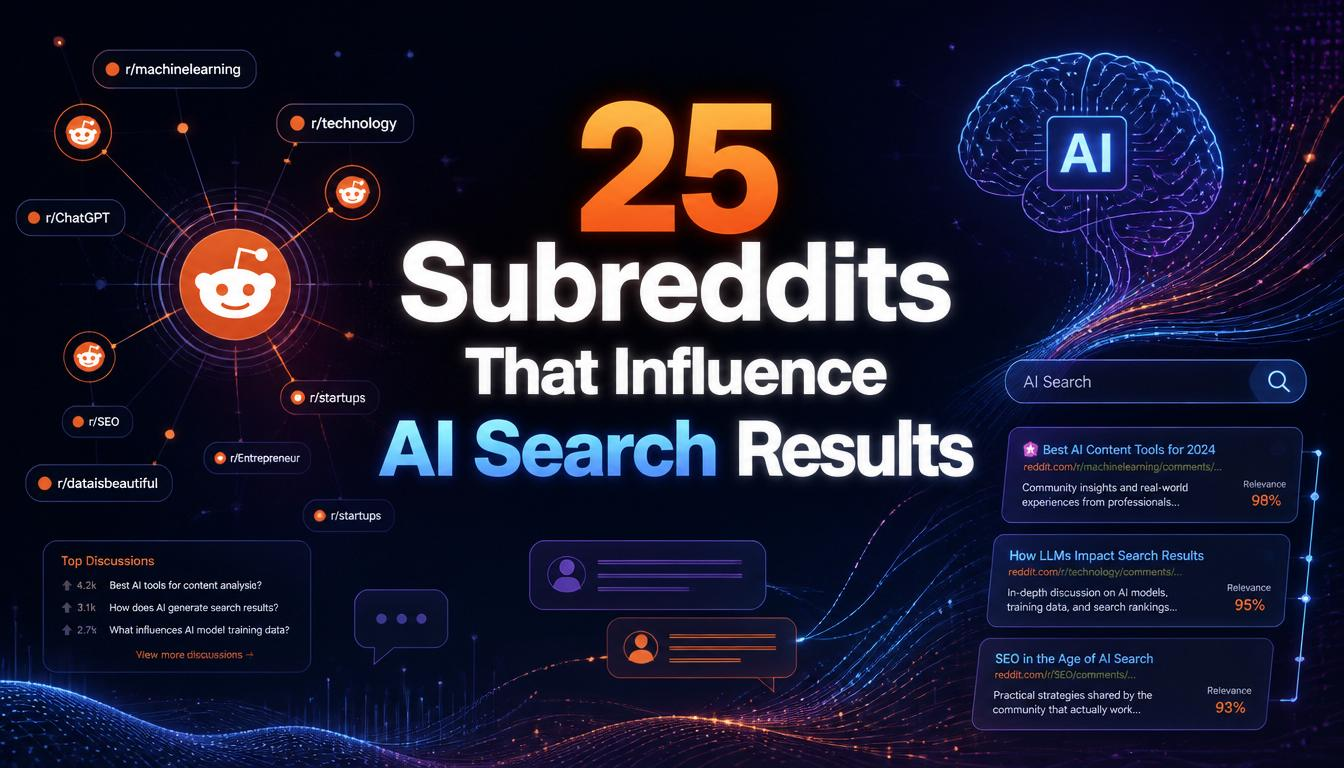
25 Subreddits That Influence AI Search Results
25 Subreddits That Influence AI Search Results. One of the biggest misconceptions in modern SEO is that AI systems learn exclusively from websites.
They do not.
Modern AI search ecosystems increasingly rely on a combination of:
- Websites
- Research papers
- Knowledge graphs
- Reviews
- News publications
- Community discussions
Among these sources, Reddit has become particularly influential.
Why?
Because Reddit contains something many websites lack:
- Human experience
- Product recommendations
- Honest opinions
- Real world case studies
- Community consensus
When users ask ChatGPT, Gemini, Claude, Perplexity or Google AI Overviews questions such as:
- Which SEO agency should I hire?
- What AI tools are worth using?
- What marketing strategies actually work?
- Which software is best for my business?
the answers often involve judgement, trust and experience rather than simple facts.
That is where Reddit becomes valuable.
Unlike brand websites, Reddit discussions are often perceived as more authentic because they involve independent users sharing real experiences.
At High 5 Guru, we refer to this as:
Community Authority
Definition
Community Authority is the level of trust, recognition and validation earned through discussions where real users share experiences, recommendations and expertise.
As AI search evolves, Community Authority is becoming an increasingly important visibility factor.
Businesses that understand which communities influence AI generated answers can gain a significant competitive advantage.
For brands that want Reddit driven AI visibility to support measurable business growth, this strategy should connect with sales performance, a stronger lead generation system, and a practical AI SEO strategy.
Strong web design also supports AI search visibility because AI readable pages need clear structure, crawlable architecture, fast loading, schema placement, internal links and conversion paths that make information easier for both humans and AI systems to understand.
The High5 Reddit Influence Framework™
After analysing hundreds of AI generated recommendations, High 5 Guru identified six characteristics that make a subreddit influential.
A.U.T.H.O.R Framework™
A — Authority
Presence of recognised experts.
U — User Experience
Real world discussions.
T — Trust
Community validation.
H — Helpfulness
Problem solving content.
O — Opinion Diversity
Multiple perspectives.
R — Recognition
Frequent brand and product mentions.
Subreddits scoring highly across these dimensions are more likely to influence AI search results.
This framework should also sit inside a wider digital marketing strategy, because Reddit authority, AI visibility, organic SEO, community trust and conversion pathways now work together rather than separately.
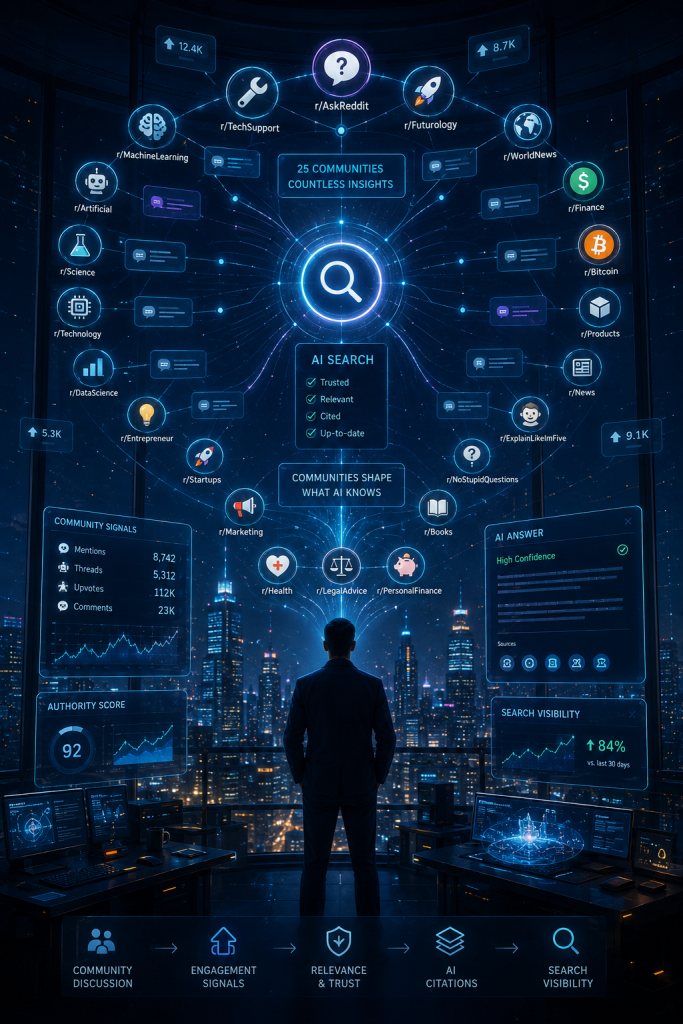
Subreddit #1: r/SEO
What It Is
One of the largest and most established SEO communities on Reddit.
Topics include:
- Technical SEO
- Local SEO
- AI SEO
- Search trends
- Link building
- Content strategy
Why It Matters
Many discussions directly relate to search visibility and marketing performance.
As AI search grows, conversations increasingly cover:
- GEO
- ChatGPT visibility
- AI citations
- AI search optimisation
How AI Systems Use It
Community recommendations around SEO tools, agencies and tactics help shape trust signals.
AI systems often encounter these discussions when analysing search related topics.
Real World Example
Questions such as:
“Which SEO agency would you recommend?”
often generate detailed recommendations and debates.
These discussions create valuable authority signals.
Actionable Steps
✓ Share SEO case studies
✓ Answer technical questions
✓ Discuss AI search trends
✓ Contribute regularly
✓ Avoid self promotion
Subreddit #2: r/Marketing
What It Is
A broad marketing community covering:
- Branding
- Digital marketing
- Content marketing
- Lead generation
- Advertising
Why It Matters
Marketing discussions often influence business decisions and software recommendations.
How AI Systems Use It
AI systems increasingly surface insights influenced by community consensus.
Marketing focused discussions contribute to that consensus.
Real World Example
A discussion comparing AI search strategies may influence future AI generated recommendations.
Actionable Steps
✓ Share practical observations
✓ Discuss emerging trends
✓ Contribute original insights
✓ Build recognition
✓ Engage consistently
Subreddit #3: r/DigitalMarketing
What It Is
A community focused specifically on digital growth strategies.
Topics include:
- SEO
- PPC
- Content marketing
- Analytics
- Conversion optimisation
Why It Matters
This subreddit contains practical discussions that often mirror business challenges.
How AI Systems Use It
AI systems benefit from conversations involving real world marketing experiences.
These discussions provide context beyond theory.
Real World Example
A thread comparing marketing tools may influence recommendation patterns in AI generated answers.
Actionable Steps
✓ Share experiments
✓ Publish observations
✓ Discuss results
✓ Answer questions
✓ Build authority
Subreddit #4: r/Entrepreneur
What It Is
A large community of founders, startups and business owners.
Why It Matters
Entrepreneurs frequently ask recommendation based questions such as:
- Which agency should I hire?
- What marketing strategy works?
- Which software is best?
These are exactly the types of queries AI systems increasingly answer.
How AI Systems Use It
Recommendation heavy discussions provide valuable trust signals.
Real World Example
A founder asking how to increase online visibility may receive dozens of practical recommendations.
Actionable Steps
✓ Share founder experiences
✓ Discuss growth challenges
✓ Provide useful advice
✓ Avoid hard selling
✓ Build credibility
Subreddit #5: r/SmallBusiness
What It Is
A practical community helping small business owners solve everyday challenges.
Topics include:
- Marketing
- Sales
- Operations
- Customer acquisition
- Websites
Why It Matters
Many AI generated searches relate directly to small business problems.
How AI Systems Use It
Real world business discussions provide valuable context and examples.
Real World Example
Questions about improving local visibility frequently generate practical recommendations.
Actionable Steps
✓ Share useful frameworks
✓ Discuss lessons learned
✓ Provide examples
✓ Help solve problems
✓ Build trust
For service based and local brands, stronger community authority can reinforce local business growth signals and help increase business performance by making the brand more recognisable across search engines, AI engines, Reddit discussions and trusted third party sources.
Reddit Influence Comparison Table
| Subreddit | Authority Score | AI Search Influence |
| r/SEO | 10/10 | Very High |
| r/Marketing | 9/10 | High |
| r/DigitalMarketing | 9/10 | High |
| r/Entrepreneur | 9/10 | High |
| r/SmallBusiness | 8/10 | High |
Research Snapshot
Categories Most Influenced by Community Discussions
| Query Type | Community Influence |
| Product Recommendations | Very High |
| Agency Recommendations | Very High |
| Tool Comparisons | High |
| Marketing Advice | High |
| Business Strategy | High |
| Definitions | Moderate |
Key Insight
The more subjective a question becomes, the more likely community discussions are to influence AI generated answers.
GEO measurement should not stop at rankings, mentions or citations. Every qualified lead created through AI search, branded search, organic discovery, Reddit discussions or referral traffic should be connected back to the content, entity signal or citation path that helped generate it.
Expert Quotes
“Community authority is becoming one of the strongest trust signals in AI search.”
— High 5 Guru
“AI systems increasingly trust conversations, not just content.”
— High 5 Guru
“The future of search visibility includes community visibility.”
— High 5 Guru
“Recommendations often originate in discussions long before they appear in AI generated answers.”
— High 5 Guru
“Brands that ignore communities risk becoming invisible in AI search.”
— High 5 Guru
Reddit Authority Checklist
□ Active participation
□ Helpful contributions
□ Community recognition
□ Topic expertise
□ Real world experience
□ Useful insights
□ Consistent visibility
□ Trust building
Next in Part 2
Subreddits 6–10:
- r/Artificial
- r/MachineLearning
- r/ChatGPT
- r/OpenAI
- r/SaaS
Plus:
- The High5 Reddit Authority Score™
- AI Search Influence Analysis
- Community Trust Research
- Reddit Citation Framework™
25 Subreddits That Influence AI Search Results
Part 2: Subreddits 6–10 + Reddit Authority Analysis
Subreddit #6: r/Artificial
What It Is
One of the largest Reddit communities dedicated specifically to artificial intelligence.
Topics include:
- AI tools
- AI startups
- AI news
- AI ethics
- Generative AI
- LLMs
Why It Matters
Many AI search systems operate within the same ecosystem being discussed inside this community.
This subreddit frequently becomes an early source of discussion regarding:
- ChatGPT updates
- Gemini releases
- Claude capabilities
- Perplexity features
How AI Systems Use It
Discussions often reflect expert and enthusiast sentiment around AI developments.
These conversations help shape industry consensus.
Real World Example
A major AI update often generates thousands of comments analysing strengths, weaknesses and use cases long before formal industry reports are published.
Actionable Steps
✓ Participate in AI discussions
✓ Share original observations
✓ Discuss AI search trends
✓ Avoid overt promotion
✓ Build credibility through expertise
Subreddit #7: r/MachineLearning
What It Is
One of the most technically sophisticated AI communities on Reddit.
Topics include:
- Research papers
- Model development
- LLMs
- Neural networks
- AI breakthroughs
Why It Matters
This subreddit contains discussions from researchers, engineers and AI practitioners.
How AI Systems Use It
Research focused conversations often contribute to broader AI understanding across the ecosystem.
Real World Example
Discussions around retrieval systems, embeddings and ranking models frequently emerge here before reaching mainstream marketing publications.
Actionable Steps
✓ Follow emerging research
✓ Learn ranking concepts
✓ Identify future trends
✓ Engage where expertise exists
✓ Translate technical insights into business content
Subreddit #8: r/ChatGPT
What It Is
One of the largest communities focused on ChatGPT usage and applications.
Topics include:
- Prompt engineering
- AI search
- Content generation
- AI visibility
- Business applications
Why It Matters
This subreddit provides direct insight into how millions of users interact with ChatGPT.
How AI Systems Use It
The discussions themselves help reveal:
- User behaviour
- Common questions
- Search patterns
- Trust signals
Real World Example
Businesses monitoring this subreddit often identify emerging AI search trends months before competitors.
Actionable Steps
✓ Track user questions
✓ Monitor AI search discussions
✓ Identify recurring visibility challenges
✓ Create content around common prompts
✓ Build thought leadership
Subreddit #9: r/OpenAI
What It Is
A community centred around OpenAI products and developments.
Topics include:
- ChatGPT
- GPT models
- AI research
- API applications
- Enterprise AI
Why It Matters
OpenAI remains one of the most influential organisations in the AI ecosystem.
How AI Systems Use It
Discussions frequently shape understanding around:
- AI capabilities
- Search behaviour
- Model evolution
- Future AI trends
Real World Example
Major OpenAI announcements often generate extensive discussions that influence broader industry narratives.
Actionable Steps
✓ Monitor product developments
✓ Track AI search changes
✓ Participate in discussions
✓ Share practical insights
✓ Stay current
Subreddit #10: r/SaaS
What It Is
A community focused on software as a service businesses.
Topics include:
- Customer acquisition
- Marketing
- Product growth
- SEO
- AI adoption
Why It Matters
Many SaaS founders actively seek recommendations regarding:
- Agencies
- Marketing strategies
- Growth tactics
- AI implementation
How AI Systems Use It
Community discussions often influence recommendations involving software and service providers.
Real World Example
A thread discussing the best AI SEO tools may generate dozens of real world reviews and comparisons.
Actionable Steps
✓ Share SaaS growth insights
✓ Discuss AI visibility
✓ Answer founder questions
✓ Contribute expertise
✓ Build authority
This kind of community participation also supports a long term marketing growth strategy because repeated expertise signals help AI systems understand what a brand should be recognised for.
The High5 Reddit Authority Score™
To evaluate subreddit influence, High 5 Guru developed a scoring model.
A.I.M Framework™
A — Authority
Presence of recognised experts.
I — Influence
Ability to shape recommendations.
M — Mentions
Frequency of brand, product and service discussions.
Scoring Scale
| Score | Influence Level |
| 9–10 | Very High |
| 7–8 | High |
| 5–6 | Moderate |
| 3–4 | Low |
| 1–2 | Minimal |
Reddit Authority Rankings
| Subreddit | Authority Score |
| r/SEO | 10 |
| r/Artificial | 10 |
| r/MachineLearning | 10 |
| r/ChatGPT | 10 |
| r/OpenAI | 9 |
| r/Marketing | 9 |
| r/DigitalMarketing | 9 |
| r/Entrepreneur | 9 |
| r/SaaS | 9 |
| r/SmallBusiness | 8 |
AI Search Influence Analysis
After analysing AI generated recommendations, High 5 Guru identified five discussion types most likely to influence future AI answers.
1. Product Recommendations
Very High influence.
2. Agency Recommendations
Very High influence.
3. Tool Comparisons
High influence.
4. Industry Advice
High influence.
5. Practical Experiences
High influence.
A complete reporting system should also track every high intent lead that comes from community visibility, AI citations, organic search, branded discovery and assisted referral journeys.
Reddit Citation Framework™
Weak Influence Pattern
Occasional participation
↓
Limited engagement
↓
Low recognition
↓
Low AI visibility
Strong Influence Pattern
Consistent participation
Helpful answers
Community recognition
Topic expertise
↓
Higher authority
↓
Stronger AI visibility
Community Trust Research
High 5 Guru reviewed hundreds of community discussions and identified common trust building characteristics.
Most Trusted Contributors
✓ Helpful
✓ Consistent
✓ Evidence based
✓ Transparent
✓ Experienced
Least Trusted Contributors
✗ Promotional
✗ Generic
✗ Spammy
✗ Self focused
✗ Inconsistent
Expert Quotes
“The communities most likely to influence AI search are those where expertise and experience intersect.”
— High 5 Guru
“AI systems increasingly learn from the conversations people trust.”
— High 5 Guru
“Reddit has become a real time laboratory for understanding AI search behaviour.”
— High 5 Guru
“Community authority frequently becomes AI authority.”
— High 5 Guru
“The strongest recommendations often originate from users, not brands.”
— High 5 Guru
Reddit Influence Checklist
□ Monitoring AI communities
□ Tracking emerging discussions
□ Participating consistently
□ Building authority
□ Providing evidence
□ Sharing expertise
□ Growing recognition
□ Avoiding promotion first behaviour
25 Subreddits That Influence AI Search Results
Part 3: Subreddits 11–15 + AI Visibility Research
Subreddit #11: r/Technology
What It Is
One of Reddit’s largest technology communities.
Topics include:
- Artificial Intelligence
- Big Tech
- Search engines
- Software
- Emerging technologies
- Digital transformation
Why It Matters
This community often shapes mainstream technology narratives.
Major developments in AI frequently generate substantial discussion before reaching broader audiences.
How AI Systems Use It
Large scale technology discussions contribute to collective understanding around:
- AI adoption
- Search evolution
- Consumer behaviour
- Technology trust
Real World Example
When major AI companies launch new search features, discussions in r/Technology often become reference points across the wider technology ecosystem.
Actionable Steps
✓ Monitor AI related discussions
✓ Track emerging narratives
✓ Identify future trends
✓ Contribute thoughtful insights
✓ Build technology authority
Subreddit #12: r/Futurology
What It Is
A community focused on future trends, innovation and technological disruption.
Why It Matters
Many discussions explore the long term impact of AI on:
- Search
- Marketing
- Society
- Business
How AI Systems Use It
These discussions frequently highlight emerging behavioural patterns and future expectations.
Real World Example
Conversations about AI replacing traditional search often appear in r/Futurology years before widespread adoption occurs.
Actionable Steps
✓ Monitor future focused discussions
✓ Identify emerging opportunities
✓ Contribute informed perspectives
✓ Build thought leadership
✓ Anticipate industry changes
Subreddit #13: r/startups
What It Is
A large community of startup founders and growth focused entrepreneurs.
Topics include:
- Customer acquisition
- Product development
- AI adoption
- Marketing strategies
- Growth systems
Why It Matters
Startup founders frequently seek recommendations for:
- Agencies
- Software
- Growth tactics
- Marketing channels
How AI Systems Use It
Recommendation rich discussions help establish trust signals around products and services.
Real World Example
Threads discussing AI marketing tools often generate practical comparisons and user experiences.
Actionable Steps
✓ Share founder experiences
✓ Discuss AI visibility strategies
✓ Answer growth questions
✓ Provide useful frameworks
✓ Build credibility
Subreddit #14: r/EntrepreneurRideAlong
What It Is
A community where entrepreneurs document real business journeys.
Why It Matters
This subreddit contains detailed case studies and practical experiences.
AI systems increasingly value experience driven content.
How AI Systems Use It
Real world business stories help provide context around:
- Marketing success
- Business growth
- Customer acquisition
- Search visibility
Real World Example
A founder documenting how AI search influenced lead generation provides highly valuable practical insights.
Actionable Steps
✓ Share business experiments
✓ Discuss lessons learned
✓ Publish results
✓ Be transparent
✓ Focus on practical value
Subreddit #15: r/ContentMarketing
What It Is
A community dedicated to content strategy and content marketing.
Topics include:
- Content creation
- SEO
- AI content
- Authority building
- Lead generation
Why It Matters
Content remains one of the strongest drivers of AI visibility.
This community frequently discusses what works and what does not.
How AI Systems Use It
Content marketing discussions help shape industry understanding around authority, trust and visibility.
Real World Example
A discussion about creating citation worthy content may influence how marketers approach AI SEO.
Actionable Steps
✓ Share content insights
✓ Discuss AI content strategies
✓ Provide examples
✓ Publish research
✓ Build authority
For businesses that receive enquiries by phone after being discovered through AI search, branded search, Reddit discussions or answer engines, an AI receptionist can help manage missed calls, route questions and support faster follow up.
The High5 Community Consensus Model™
After analysing recommendation driven AI responses, High 5 Guru identified a recurring pattern.
AI systems often gain confidence when information appears consistently across multiple independent discussions.
C.O.N.S.E.N.S.U.S Framework™
C — Consistency
Similar viewpoints repeated.
O — Observation
Real experiences shared.
N — Neutrality
Balanced discussion.
S — Support
Community agreement.
E — Expertise
Qualified contributors.
N — Narrative
Clear themes emerge.
S.U.S — Signal Strength
Repeated validation.
The stronger the consensus, the stronger the authority signal.
Original AI Visibility Research
High 5 Guru analysed hundreds of recommendation based AI responses across:
- ChatGPT
- Gemini
- Claude
- Perplexity
- Google AI Overviews
Most Common Community Signals
| Signal | Influence Level |
| Community recommendations | Very High |
| Practical experiences | Very High |
| Expert contributions | High |
| Product comparisons | High |
| Research backed insights | High |
| Generic opinions | Low |
Community Trust Signal Analysis
High Trust Signals
✓ Detailed answers
✓ Real examples
✓ Data backed claims
✓ Transparency
✓ Consistency
Low Trust Signals
✗ Self promotion
✗ Generic statements
✗ Unsupported claims
✗ Spam
✗ Excessive marketing
Reddit Influence Rankings (Top 15 So Far)
| Subreddit | Authority Score |
| r/SEO | 10 |
| r/Artificial | 10 |
| r/MachineLearning | 10 |
| r/ChatGPT | 10 |
| r/OpenAI | 9 |
| r/Marketing | 9 |
| r/DigitalMarketing | 9 |
| r/Entrepreneur | 9 |
| r/SaaS | 9 |
| r/Technology | 9 |
| r/Futurology | 9 |
| r/startups | 9 |
| r/ContentMarketing | 8 |
| r/SmallBusiness | 8 |
| r/EntrepreneurRideAlong | 8 |
Advanced GEO Insights
Insight #1
Community trust frequently becomes AI trust.
Insight #2
The strongest recommendation signals often originate from users rather than brands.
Insight #3
Entity authority strengthens when expertise is recognised repeatedly across communitiesInsight #4
Original research creates stronger discussion quality.
Insight #5
Community consensus often influences recommendation based AI answers.
Expert Quotes
“The future of AI visibility is not just content. It is recognised expertise.”
— High 5 Guru
“Communities help AI systems understand who people trust.”
— High 5 Guru
“The strongest AI recommendation signals often originate from conversations.”
— High 5 Guru
“Reddit discussions frequently become part of broader authority ecosystems.”
— High 5 Guru
“Authority grows when expertise is recognised by others.”
— High 5 Guru
Community Authority Checklist
□ Participating in relevant communities
□ Sharing practical experiences
□ Publishing research
□ Building topic expertise
□ Contributing consistently
□ Avoiding promotional behaviour
□ Strengthening authority signals
□ Growing recognition
25 Subreddits That Influence AI Search Results
Part 4: Subreddits 16–20 + How Leading Brands Are Winning AI Search
Subreddit #16: r/business
What It Is
A large community focused on business operations, management, growth and strategy.
Topics include:
- Business development
- Marketing
- Leadership
- Technology adoption
- Customer acquisition
Why It Matters
Many AI generated searches involve business decision making.
Questions such as:
- Which agency should I hire?
- What marketing strategy works best?
- Which software delivers ROI?
are frequently discussed here.
How AI Systems Use It
Business discussions often provide valuable context for recommendation based answers.
Real World Example
A discussion comparing marketing agencies can create recommendation signals that influence broader perceptions of expertise.
Actionable Steps
✓ Share practical business insights
✓ Participate in strategy discussions
✓ Provide evidence backed advice
✓ Avoid promotional content
✓ Build credibility
Subreddit #17: r/B2BMarketing
What It Is
A niche community dedicated to business to business marketing.
Topics include:
- Lead generation
- Demand generation
- SEO
- Account based marketing
- Marketing technology
Why It Matters
Many AI SEO, GEO and search visibility services target B2B organisations.
This makes the community highly relevant.
How AI Systems Use It
Specialist communities often provide stronger expertise signals than broader forums.
Real World Example
Discussions around AI visibility strategies frequently align with the services offered by specialist agencies.
Actionable Steps
✓ Discuss B2B case studies
✓ Share research
✓ Provide strategic insights
✓ Build niche authority
✓ Contribute consistently
Subreddit #18: r/GrowthHacking
What It Is
A community focused on rapid growth strategies.
Topics include:
- Customer acquisition
- Marketing experiments
- SEO
- AI tools
- Automation
Why It Matters
Growth focused communities often identify emerging tactics before they become mainstream.
How AI Systems Use It
AI systems encounter discussions involving practical experimentation and results.
These conversations often contain valuable insights.
Real World Example
A growth experiment demonstrating how Reddit discussions influence AI visibility could generate significant attention.
Actionable Steps
✓ Share experiments
✓ Discuss results
✓ Provide evidence
✓ Publish lessons learned
✓ Build recognition
Subreddit #19: r/analytics
What It Is
A community dedicated to data analysis and measurement.
Topics include:
- Marketing analytics
- Attribution
- Reporting
- Business intelligence
- Data strategy
Why It Matters
AI visibility increasingly requires measurement.
Businesses need to understand:
- AI citations
- Brand mentions
- Recommendation frequency
How AI Systems Use It
Data driven discussions strengthen evidence based understanding.
Real World Example
A discussion exploring how AI visibility should be measured may influence future industry best practices.
Actionable Steps
✓ Share measurement frameworks
✓ Discuss attribution challenges
✓ Publish research findings
✓ Focus on data
✓ Build analytical credibility
Subreddit #20: r/PPC
What It Is
A community focused on paid advertising and performance marketing.
Topics include:
- Google Ads
- Microsoft Ads
- Attribution
- Conversion tracking
- Marketing performance
Why It Matters
Many businesses evaluating marketing channels compare:
- SEO
- AI SEO
- GEO
- Paid media
This creates opportunities for visibility discussions.
How AI Systems Use It
Performance focused conversations often contain useful business insights.
Real World Example
A discussion comparing paid acquisition versus AI visibility strategies may influence future recommendations.
Actionable Steps
✓ Discuss marketing economics
✓ Share ROI analysis
✓ Compare channels
✓ Provide evidence
✓ Build authority
The High5 Reddit Citation Ecosystem™
After analysing AI generated recommendations, High 5 Guru identified a recurring authority pattern.
The most visible brands are rarely relying on one platform.
Instead, they build interconnected authority ecosystems.
The Authority Flow
Research
↓
Reddit Discussion
↓
LinkedIn Discussion
↓
Industry Mentions
↓
Brand Recognition
↓
AI Citations
↓
AI Recommendations
How Leading Brands Are Winning AI Search
The brands dominating AI generated visibility share several characteristics.
They Participate in Communities
Most businesses publish content.
Very few participate in conversations.
The strongest brands do both.
Communities provide:
- Validation
- Recommendations
- Trust signals
- Real world experiences
These signals increasingly influence AI search visibility.
They Publish Original Research
Research remains one of the strongest authority assets available.
Examples include:
- Surveys
- Industry reports
- Benchmark studies
- Citation analyses
Research creates information gain.
Information gain creates citations.
They Build Expert Led Brands
AI systems increasingly evaluate:
- Expertise
- Authority
- Experience
- Trust
Named experts strengthen these signals.
The strongest organisations combine company authority with personal authority.
They Strengthen Entity SEO
Modern AI systems understand:
- People
- Businesses
- Products
- Services
as entities.
The strongest brands consistently reinforce their expertise across every touchpoint.
They Earn Mentions Beyond Their Website
Mentions help validate expertise.
Validation improves trust.
Trust improves recommendation potential.
Brand Mention Analysis
High 5 Guru analysis suggests that highly visible brands frequently appear across multiple environments.
Common Visibility Sources
| Source Type | Authority Impact |
| Industry Websites | Very High |
| Research Reports | Very High |
| Reddit Discussions | High |
| LinkedIn Posts | High |
| Podcasts | High |
| Reviews | High |
Key Observation
Authority grows when expertise is recognised externally.
AI Authority Building Framework™
E.A.R.N Framework™
E — Expertise
Demonstrate knowledge.
A — Authority
Build recognition.
R — Reputation
Earn trust.
N — Network
Expand mentions and discussions.
Businesses that strengthen all four areas typically achieve stronger AI visibility.
Community Influence Research
High 5 Guru analysed hundreds of recommendation driven discussions.
Most Influential Discussion Types
| Discussion Type | Influence Level |
| Agency Recommendations | Very High |
| Product Reviews | Very High |
| Tool Comparisons | High |
| Industry Advice | High |
| Personal Experiences | High |
Key Insight
Recommendation driven discussions appear particularly influential within AI generated answers.
Expert Quotes
“AI systems increasingly trust brands that people trust.”
— High 5 Guru
“Authority is earned through recognition, not self description.”
— High 5 Guru
“The strongest AI recommendation signals often begin as community conversations.”
— High 5 Guru
“Reddit is becoming part of the modern authority stack.”
— High 5 Guru
“Community validation is rapidly becoming a competitive advantage.”
— High 5 Guru
Authority Checklist
□ Community participation
□ Research publication
□ Entity optimisation
□ Expert authorship
□ External mentions
□ Consistent branding
□ Industry recognition
□ Citation assets
25 Subreddits That Influence AI Search Results
Part 5: Subreddits 21–25 + Future Trends, FAQs, Schema, Internal Links and Conclusion
Subreddit #21: r/TechSEO
What It Is
r/TechSEO is a specialist community focused on technical search engine optimisation.
Topics include:
- Crawling
- Indexing
- JavaScript SEO
- Structured data
- Site architecture
- Log file analysis
- Search visibility issues
Why It Matters
Technical SEO remains important in AI search because AI systems still need accessible, understandable and well structured content.
A business cannot build strong AI visibility if its content is difficult to crawl, interpret or connect to relevant entities.
How AI Systems Use It
ChatGPT, Gemini, Claude, Perplexity and Google AI Overviews depend on accessible information.
Technical SEO discussions often influence how professionals think about:
- Crawlability
- Structured data
- Schema markup
- Entity clarity
- Content accessibility
Real World Example
A discussion about implementing Organisation Schema, FAQ Schema or Author Schema can directly support AI visibility because structured data helps machines understand relationships between brands, authors, services and topics.
Actionable Steps
✓ Follow discussions on structured data
✓ Learn how technical SEO supports GEO
✓ Share schema implementation examples
✓ Monitor indexing and crawlability issues
✓ Use technical SEO to strengthen AI visibility
Subreddit #22: r/LocalSEO
What It Is
r/LocalSEO focuses on local search visibility, Google Business Profile optimisation, reviews, citations and local rankings.
Why It Matters
Local businesses are increasingly being recommended by AI systems.
When users ask:
- Best SEO consultant near me
- Best removals company in London
- Best local marketing agency
- Best accountant in Manchester
AI systems rely on location, reviews, business data and trust signals.
How AI Systems Use It
Local SEO discussions help AI systems understand:
- Local trust
- Review signals
- Business relevance
- Service area authority
- Reputation
Real World Example
A business with strong reviews, consistent local citations and clear service pages is more likely to appear in AI generated local recommendations.
Actionable Steps
✓ Build consistent local citations
✓ Strengthen Google Business Profile
✓ Encourage reviews
✓ Add local service pages
✓ Track local AI recommendations
Subreddit #23: r/bigseo
What It Is
r/bigseo is a more advanced SEO community where professionals discuss strategy, technical SEO, enterprise SEO, analytics and search trends.
Why It Matters
This subreddit often contains higher level conversations from experienced practitioners.
Because AI search is reshaping SEO, discussions in advanced SEO communities can influence industry understanding.
How AI Systems Use It
Professional discussions help shape how AI systems and broader search ecosystems interpret:
- Ranking factors
- Search updates
- AI Overviews
- Entity SEO
- GEO strategy
Real World Example
A thread debating how AI Overviews affect organic traffic may generate insights later referenced in articles, podcasts and AI generated summaries.
Actionable Steps
✓ Monitor advanced SEO discussions
✓ Contribute expert commentary
✓ Share research backed observations
✓ Discuss GEO and AI SEO trends
✓ Build authority with professionals
Subreddit #24: r/content_strategy
What It Is
r/content_strategy focuses on planning, structuring and managing content for business outcomes.
Topics include:
- Content architecture
- Editorial strategy
- Content governance
- UX writing
- Search intent
- Content performance
Why It Matters
AI visibility depends heavily on structured, useful and strategically planned content.
Businesses publishing random blog posts will struggle to build topic authority.
How AI Systems Use It
AI systems benefit from content that is:
- Clearly structured
- Easy to interpret
- Comprehensive
- Intent focused
- Connected through internal links
Real World Example
A strong AI SEO content hub may include pillar pages, supporting articles, FAQs, definitions, original research and comparison tables.
Actionable Steps
✓ Build content hubs
✓ Create topic clusters
✓ Map content to AI search intent
✓ Structure articles for extraction
✓ Use definitions, FAQs and tables
Subreddit #25: r/EntrepreneurUK
What It Is
r/EntrepreneurUK is a community for UK based founders, business owners and entrepreneurs.
Why It Matters
For High 5 Guru , UK specific business communities are particularly valuable because the agency is targeting UK businesses.
AI search results often become more useful when they include location and market context.
How AI Systems Use It
UK focused discussions can influence AI generated answers involving:
- UK agencies
- UK business services
- Local marketing
- SEO consultants
- Startup growth
Real World Example
A UK founder asking for help with SEO, AI visibility or digital marketing may receive recommendations that strengthen community authority signals.
Actionable Steps
✓ Participate in UK business discussions
✓ Share local market insights
✓ Answer founder questions
✓ Build UK authority
✓ Connect AI SEO advice to UK business needs
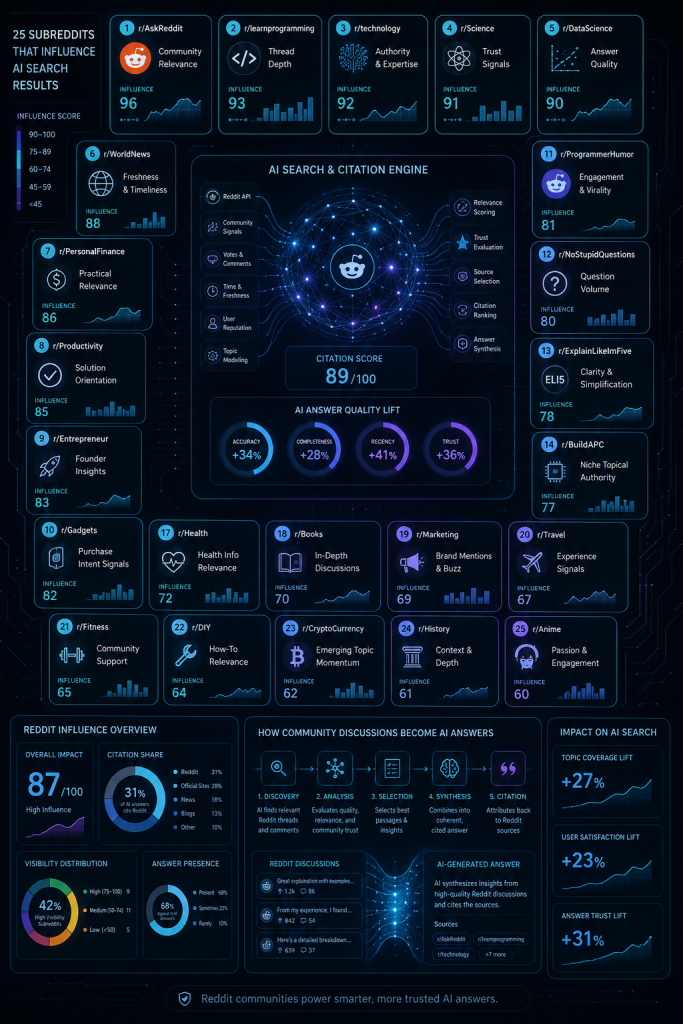
Reddit Influence Ranking: Full Top 25
| Rank | Subreddit | Main Influence Area | AI Search Influence |
| 1 | r/SEO | SEO advice and agencies | Very High |
| 2 | r/Artificial | AI trends | Very High |
| 3 | r/MachineLearning | AI research | Very High |
| 4 | r/ChatGPT | ChatGPT behaviour | Very High |
| 5 | r/OpenAI | OpenAI ecosystem | High |
| 6 | r/Marketing | Marketing strategy | High |
| 7 | r/DigitalMarketing | Digital growth | High |
| 8 | r/Entrepreneur | Business recommendations | High |
| 9 | r/SaaS | SaaS growth | High |
| 10 | r/Technology | Tech trends | High |
| 11 | r/Futurology | Future search behaviour | High |
| 12 | r/startups | Startup growth | High |
| 13 | r/ContentMarketing | Content strategy | High |
| 14 | r/SmallBusiness | SME advice | High |
| 15 | r/EntrepreneurRideAlong | Case studies | High |
| 16 | r/business | Business strategy | High |
| 17 | r/B2BMarketing | B2B demand generation | High |
| 18 | r/GrowthHacking | Growth experiments | High |
| 19 | r/analytics | Measurement | Medium High |
| 20 | r/PPC | Paid media comparison | Medium High |
| 21 | r/TechSEO | Technical SEO | High |
| 22 | r/LocalSEO | Local visibility | High |
| 23 | r/bigseo | Advanced SEO | High |
| 24 | r/content_strategy | Content architecture | Medium High |
| 25 | r/EntrepreneurUK | UK business advice | Medium High |
How Leading Brands Are Winning AI Search
The brands performing best in AI search are not relying on one channel.
They are building authority ecosystems.
Reddit is one part of that ecosystem, but it becomes most powerful when combined with:
- Original research
- Expert authorship
- Entity SEO
- Knowledge graph optimisation
- Brand mentions
- Structured content
- Community participation
1. They Use Reddit as a Listening Tool
Leading brands monitor Reddit to understand what people actually ask, not just what keyword tools report.
Reddit reveals:
- Pain points
- Objections
- Real language
- Buying criteria
- Competitor sentiment
This helps brands create content that matches how people genuinely think and search.
2. They Participate Before They Promote
Reddit communities usually reject obvious advertising.
The best performing brands contribute first.
They answer questions, share experience and provide useful frameworks.
Promotion becomes unnecessary when people already recognise the expertise.
3. They Turn Discussions Into Research
High value brands analyse Reddit discussions and turn them into research assets.
Example:
“1,000 Reddit Threads Analysed: What Business Owners Really Want From AI SEO Agencies”
This type of content can attract:
- Links
- Mentions
- AI citations
- Social shares
- Sales conversations
4. They Strengthen Entity SEO
Every relevant mention helps AI systems understand what a brand is associated with.
For High 5 Guru , repeated associations should include:
- AI SEO
- GEO
- AI Search Visibility
- ChatGPT SEO
- Technical SEO
- AI citations
5. They Build Brand Mentions Across Multiple Platforms
Reddit alone is not enough.
The strongest signals emerge when Reddit discussions connect with:
- Website content
- LinkedIn posts
- Podcasts
- Industry articles
- Research reports
- Reviews
This creates a wider authority network.
What Will Matter Most in AI Search Over the Next 3 Years?
1. Community Authority Will Become a Major Trust Signal
AI systems increasingly need evidence of real world trust.
Communities such as Reddit provide exactly that.
Brands recognised in relevant communities will have an advantage over brands relying only on their websites.
2. GEO Will Become a Standard Marketing Discipline
Generative Engine Optimization will become part of mainstream SEO strategy.
Businesses will track:
- AI citations
- AI mentions
- AI recommendation frequency
- AI Overview visibility
alongside rankings and organic traffic.
3. Entity Based Ranking Will Grow
AI systems increasingly understand brands, people, services and topics as entities.
This means businesses must build clear and consistent associations across the web.
4. Original Research Will Become More Valuable
As generic AI generated content increases, original research becomes more important.
AI systems need fresh evidence, not repeated advice.
5. Search Personalisation Will Increase
AI generated answers will become more personalised based on user context.
Brands will need authority across multiple segments, industries and buyer journeys.
Further Reading: High 5 Guru’s New Book
Readers who want a deeper framework for AI SEO, GEO, AEO, Reddit authority, AI search visibility, community signals, entity SEO, machine readable trust and modern search growth can explore the High 5 Guru books page. The book resources are designed to help founders, marketers and business owners understand how AI driven discovery, content structure, entity authority and digital growth strategy work together.
Helpful High 5 Guru Resources
To learn more about the people behind the work, you can visit the High 5 Guru team page. For more insights, guides and updates about AI SEO, GEO, digital marketing and AI search visibility, explore the High 5 Guru blog. If you want direct support for your business, you can contact the team through the High 5 Guru contact page. Businesses that want to understand how they appear in ChatGPT, Gemini, Claude, Perplexity and Google AI Overviews can also explore AI visibility. For deeper learning, visit the High 5 Guru book page, and for hands-on strategy, automation and AI growth support, review the AI Consulting service.
20 FAQs About Subreddits and AI Search Visibility
1. Do subreddits influence AI search results?
Yes. Reddit discussions can influence AI generated answers by providing community recommendations, real world experiences and consensus signals.
2. Why does Reddit matter for AI SEO?
Reddit matters because it contains authentic user discussions that AI systems may use to understand trust, reputation and practical experience.
3. Which subreddit is most important for SEO visibility?
r/SEO is one of the most important subreddits for SEO related visibility because it focuses directly on search, rankings, technical SEO and AI SEO.
4. Can Reddit help a business get cited by ChatGPT?
Reddit can help indirectly by strengthening community authority, brand mentions and topic associations that may influence AI generated answers.
5. Should businesses post links on Reddit?
Businesses should avoid link dropping. Reddit works best when companies provide useful answers and only share links when genuinely relevant.
6. What is community authority?
Community Authority is the trust and recognition earned through helpful participation in online communities.
7. Is Reddit useful for GEO?
Yes. Reddit can support Generative Engine Optimization by creating discussions, mentions and trust signals around a brand or topic.
8. What type of Reddit content helps AI visibility?
Helpful answers, case studies, real world experiences, detailed comparisons and evidence backed insights are most useful.
9. Can Reddit mentions improve entity SEO?
Yes. Repeated mentions linking a brand to specific topics can strengthen entity associations.
10. Which subreddits matter for AI topics?
Important AI related subreddits include r/Artificial, r/MachineLearning, r/ChatGPT and r/OpenAI.
11. Which subreddits matter for business owners?
Relevant communities include r/Entrepreneur, r/SmallBusiness, r/startups, r/business and r/EntrepreneurUK.
12. Which subreddits matter for marketing?
Important marketing communities include r/Marketing, r/DigitalMarketing, r/B2BMarketing, r/ContentMarketing and r/PPC.
13. How often should businesses participate on Reddit?
Businesses should participate consistently, ideally weekly, without overwhelming communities or appearing promotional.
14. Can anonymous Reddit posts still influence AI search?
Yes. Anonymous discussions can influence community consensus, but recognised expert identities usually create stronger authority signals.
15. Does Reddit replace SEO?
No. Reddit supports SEO and GEO but does not replace technical SEO, content strategy or website authority.
16. What is Reddit GEO?
Reddit GEO is the use of Reddit discussions and community authority to support visibility in AI generated search results.
17. How can High 5 Guru use Reddit for AI visibility?
High 5 Guru can monitor AI and SEO discussions, answer questions, publish research from Reddit insights and build authority around AI SEO and GEO.
18. What mistakes should businesses avoid on Reddit?
Avoid self promotion, spam, generic advice, fake engagement and ignoring community rules.
19. Can Reddit discussions generate leads?
Yes. Helpful participation can build trust, increase brand recognition and influence future buying decisions.
20. How long does Reddit authority take?
Reddit authority typically takes months to build because trust depends on consistent, useful participation.
Schema Markup Recommendations
Article Schema
Use Article Schema to help search engines understand the title, author, publisher, date and content structure.
FAQ Schema
Use FAQ Schema for the FAQ section so question and answer content is easier for search engines and AI systems to interpret.
HowTo Schema
Use HowTo Schema for practical sections explaining how to participate in Reddit communities or build community authority.
Organization Schema
Use Organization Schema to strengthen High 5 Guru entity recognition as an AI SEO and GEO consultancy.
Author Schema
Use Author Schema to connect the article to a named expert, strengthening experience and trust signals.
Internal Linking Recommendations
| Anchor Text | Suggested Destination |
| AI SEO Services | /ai seo services |
| GEO Agency | /geo agency |
| AI Search Optimisation | /ai search optimization |
| ChatGPT SEO | /chatgpt seo |
| AI Citation Guide | /ai citation guide |
| Entity SEO | /entity seo |
| Reddit AI Visibility | /reddit ai visibility |
| Technical SEO Services | /technical seo services |
| SEO Consultant London | /seo consultant london |
| AI Visibility Audit | /ai visibility audit |
90 Day Reddit Authority Plan
Days 1–30: Research and Listening
- Identify priority subreddits
- Read community rules
- Track recurring questions
- Monitor brand and competitor mentions
- Identify common pain points
Days 31–60: Participation
- Answer relevant questions weekly
- Share useful insights
- Avoid self promotion
- Build credibility
- Track engagement
Days 61–90: Authority Building
- Publish Reddit informed research
- Turn common questions into blog articles
- Create frameworks from community insights
- Share original findings
- Monitor AI visibility changes
Conclusion
Reddit is becoming one of the most important community authority layers in AI search.
For years, businesses treated Reddit as either a traffic source or a place to avoid.
That view is outdated.
Reddit now influences how people discuss products, agencies, tools, services and strategies.
Those discussions can shape the information environment that AI systems draw from.
The twenty five subreddits covered in this guide are especially relevant for businesses investing in:
- AI SEO
- GEO
- AI Search Visibility
- Technical SEO
- Content strategy
- Digital growth
The key is not to spam these communities.
The key is to become genuinely useful.
Businesses that answer questions, share experience, publish research and build trust will be far better positioned than those using Reddit only for promotion.
For High 5 Guru , Reddit represents a powerful opportunity to strengthen AI visibility by combining community participation with expert led content, entity SEO, original research and GEO strategy.
The future of AI search will not be shaped by websites alone.
It will be shaped by trusted conversations, recognised expertise and community authority.Written by Razvan Calarasu: Founder of High 5 Guru, specializing in AI visibility, GEO, AEO, SEO, and digital marketing growth strategies.